
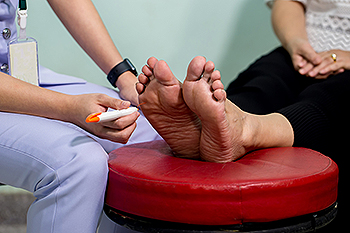
Most people associate diabetes with blood sugar and insulin levels, but many diabetics are also at risk for severe foot problems. Over time diabetes may cause nerve damage and this is commonly referred to as diabetic neuropathy. This condition can cause numbness, tingling, and pain in the feet. Once this develops you might not notice a cut or sore on the foot which could lead to an infection. Diabetes can also reduce blood flow to the feet making it even more difficult for a cut or infection to heal. Without treatment an infection may lead to gangrene, and in severe cases amputation of a toe or foot could be necessary. If you have diabetes there are ways to keep your feet healthy: inspect your feet every day for cuts, sores, scrapes, or any other changes; wash and dry your feet thoroughly; trim toenails straight across and not too short; wear socks and shoes that fit correctly; and elevate your feet while you are sitting. If you have foot wounds that won't heal, notice an odor coming from your feet, or see changes to the color or shape of your feet, it is strongly suggested that you seek the care of a podiatrist as soon as possible.
Diabetic foot care is important in preventing foot ailments such as ulcers. If you are suffering from diabetes or have any other concerns about your feet, contact one of our podiatrists from Grand Blanc Family Footcare. Our doctors can provide the care you need to keep you pain-free and on your feet.
Diabetic Foot Care
Diabetes affects millions of people every year. The condition can damage blood vessels in many parts of the body, especially the feet. Because of this, taking care of your feet is essential if you have diabetes, and having a podiatrist help monitor your foot health is highly recommended.
The Importance of Caring for Your Feet
Patients with diabetes should have their doctor monitor their blood levels, as blood sugar levels play such a huge role in diabetic care. Monitoring these levels on a regular basis is highly advised.
It is always best to inform your healthcare professional of any concerns you may have regarding your feet, especially for diabetic patients. Early treatment and routine foot examinations are keys to maintaining proper health, especially because severe complications can arise if proper treatment is not applied.
If you have any questions please feel free to contact our office located in Grand Blanc, MI . We offer the newest diagnostic and treatment technologies for all your foot and ankle needs.

Podiatrists are physicians, and often surgeons, who have studied the foot, ankle, and lower leg, along with all associated ailments. They have received an undergraduate degree as well as medical degree and undergo four years of postgraduate study with a three-year residency. They treat a variety of foot and ankle issues, including fungal and ingrown toenails, heel pain, fractures, ankle sprains and strains, nerve damage (neuromas), bunions, hammertoe, arthritis, wound care, and complications of the feet due to diabetes and peripheral artery disease, and much more. They can also perform surgeries to treat certain foot and ankle conditions, perform gait analyses, and fit and create custom orthotics for their patients. If you experience any discomfort in your feet or ankles or are having a hard time getting around, make an appointment with a podiatrist who can get to the bottom of your condition and treat it accordingly.
Wound care is an important part in dealing with diabetes. If you have diabetes and a foot wound or would like more information about wound care for diabetics, consult with one of our podiatrists from Grand Blanc Family Footcare. Our doctors will assess your condition and provide you with quality foot and ankle treatment.
What Is Wound Care?
Wound care is the practice of taking proper care of a wound. This can range from the smallest to the largest of wounds. While everyone can benefit from proper wound care, it is much more important for diabetics. Diabetics often suffer from poor blood circulation which causes wounds to heal much slower than they would in a non-diabetic.
What Is the Importance of Wound Care?
While it may not seem apparent with small ulcers on the foot, for diabetics, any size ulcer can become infected. Diabetics often also suffer from neuropathy, or nerve loss. This means they might not even feel when they have an ulcer on their foot. If the wound becomes severely infected, amputation may be necessary. Therefore, it is of the upmost importance to properly care for any and all foot wounds.
How to Care for Wounds
The best way to care for foot wounds is to prevent them. For diabetics, this means daily inspections of the feet for any signs of abnormalities or ulcers. It is also recommended to see a podiatrist several times a year for a foot inspection. If you do have an ulcer, run the wound under water to clear dirt from the wound; then apply antibiotic ointment to the wound and cover with a bandage. Bandages should be changed daily and keeping pressure off the wound is smart. It is advised to see a podiatrist, who can keep an eye on it.
If you have any questions, please feel free to contact our office located in Grand Blanc, MI . We offer the newest diagnostic and treatment technologies for all your foot care needs.
 It’s important to know that shoes for toddlers and shoes for older children are not the same. The final foot bone is only beginning to form at about 3 years of age, and feet will not be fully developed until the teen years. It’s wise to choose shoes for toddlers that offer proper support, and make sure the child’s feet are accurately measured in both length and width. Although the shoes should be lightweight, they also should have a sturdy, flat sole. Because a small child’s foot grows so rapidly, it is suggested to replace shoes every three months to ensure they fit correctly. Seeing a podiatrist for information on the best shoes for your baby is recommended.
Making sure that your children maintain good foot health is very important as they grow. If you have any questions, contact one of our podiatrists of Grand Blanc Family Footcare. Our doctors can provide the care you need to keep you pain-free and on your feet.
Keeping Children's Feet Healthy
Having healthy feet during childhood can help prevent medical problems later in life, namely in the back and legs. As children grow, their feet require different types of care. Here are some things to consider...
Although babies do not walk yet, it is still very important to take care of their feet.
Avoid putting tight shoes or socks on his or her feet.
Allow the baby to stretch and kick his or her feet to feel comfortable.
As a toddler, kids are now on the move and begin to develop differently. At this age, toddlers are getting a feel for walking, so don’t be alarmed if your toddler is unsteady or ‘walks funny’.
As your child gets older, it is important to teach them how to take care of their feet.
Show them proper hygiene to prevent infections such as fungus.
Be watchful for any pain or injury.
Have all injuries checked by a doctor as soon as possible.
Comfortable, protective shoes should always be worn, especially at play.
If you have any questions please feel free to contact our office located in Grand Blanc, MI . We offer the newest diagnostic and treatment technologies for all your foot and ankle needs.

Gout is a painful, inflammatory form of arthritis. Those affected will typically feel an intense stiffness in the joints of their feet, particularly in the big toe. Schedule a visit to learn about how gout can be managed and treated.

Gout is a form of arthritis where excess uric acid in the bloodstream crystallizes on joints in the body. Although other joints in the body can be affected by gout, it typically occurs in the joint of the big toe. Gout flares are intense attacks of pain, inflammation and sometimes redness and warmth in the skin around the affected joint. These flare-ups often occur at night and typically last from 12 hours to a few days. People who are male, overweight, over 40, or who suffer from angina, kidney disease, diabetes, high blood pressure or psoriasis are more at risk of developing gout. Additionally, consuming sugary drinks and foods rich in purines, as well as certain medications are believed to contribute to the formation of this painful condition. If you are experiencing painful flare ups in your big toe joint and fall into one of these categories, make an appointment with a podiatrist. By taking a sample of fluid from the affected toe and performing an examination, they can determine if the cause of your discomfort is gout, and help treat it.
Gout is a painful condition that can be treated. If you are seeking treatment, contact one of our podiatrists from Grand Blanc Family Footcare. Our doctors will treat your foot and ankle needs.
What Is Gout?
Gout is a form of arthritis that is characterized by sudden, severe attacks of pain, redness, and tenderness in the joints. The condition usually affects the joint at the base of the big toe. A gout attack can occur at any random time, such as the middle of the night while you are asleep.
Symptoms
Risk Factors
Prior to visiting your podiatrist to receive treatment for gout, there are a few things you should do beforehand. If you have gout you should write down your symptoms--including when they started and how often you experience them, important medical information you may have, and any questions you may have. Writing down these three things will help your podiatrist in assessing your specific situation so that he or she may provide the best route of treatment for you.
If you have any questions, please feel free to contact our office located in Grand Blanc, MI . We offer the newest diagnostic and treatment technologies for all your foot care needs.


 Theme - Default